

High Outbound Activity but No Pipeline? How to Find the Broken Stage
High outbound activity but little qualified pipeline? Find the broken stage across targeting, deliverability, messaging, meetings, qualification, and CRM tracking.
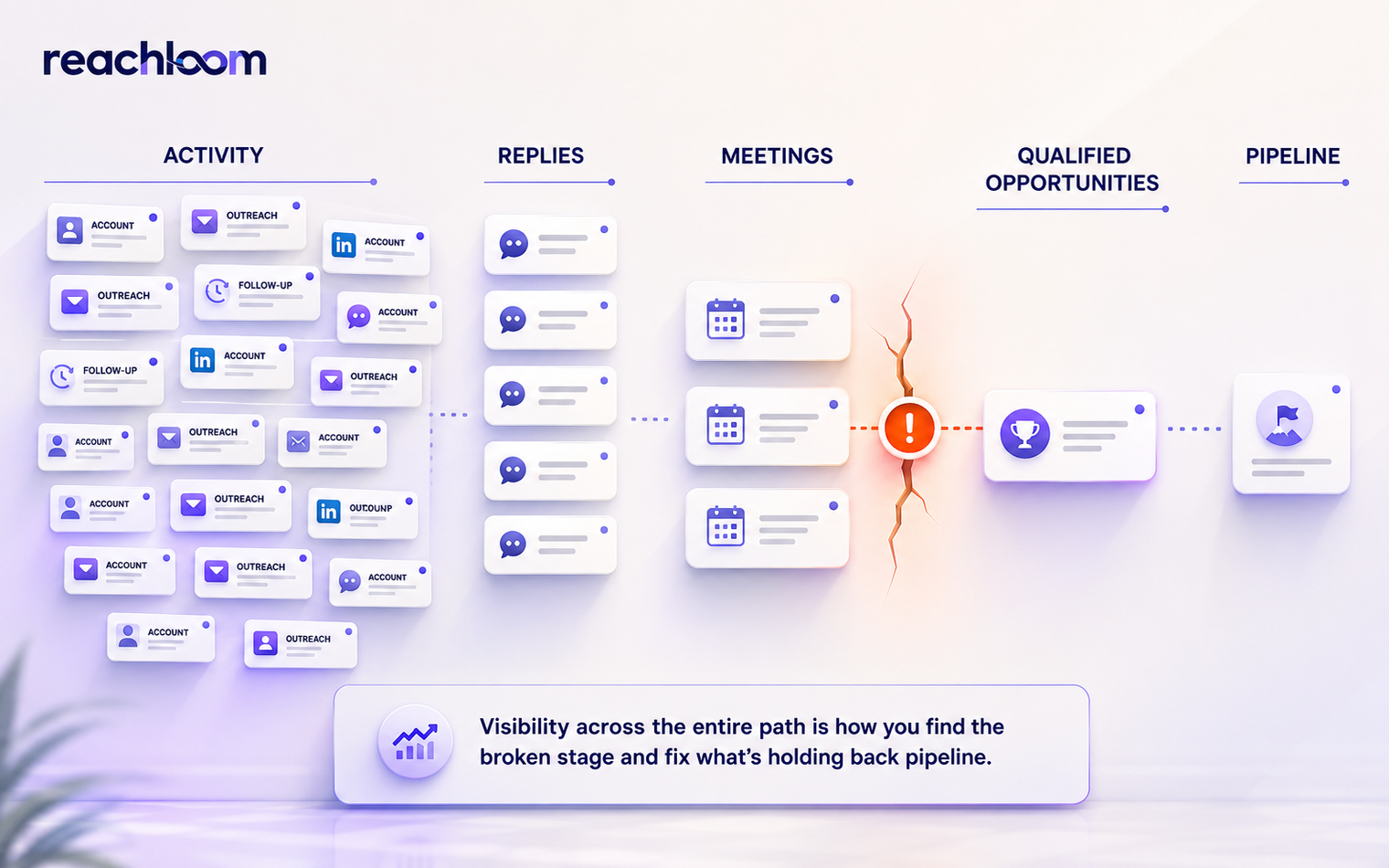
Your team is sending emails.
LinkedIn activity is up.
SDRs are working through their lists.
Sequences are running.
The CRM shows plenty of activity.
But qualified pipeline is barely moving.
When that happens, increasing activity is usually the wrong first response.
The better question is:
Where does acceptable activity stop turning into an acceptable outcome?
That is the stage you need to diagnose first.
A useful outbound audit should follow the conversion chain from left to right:
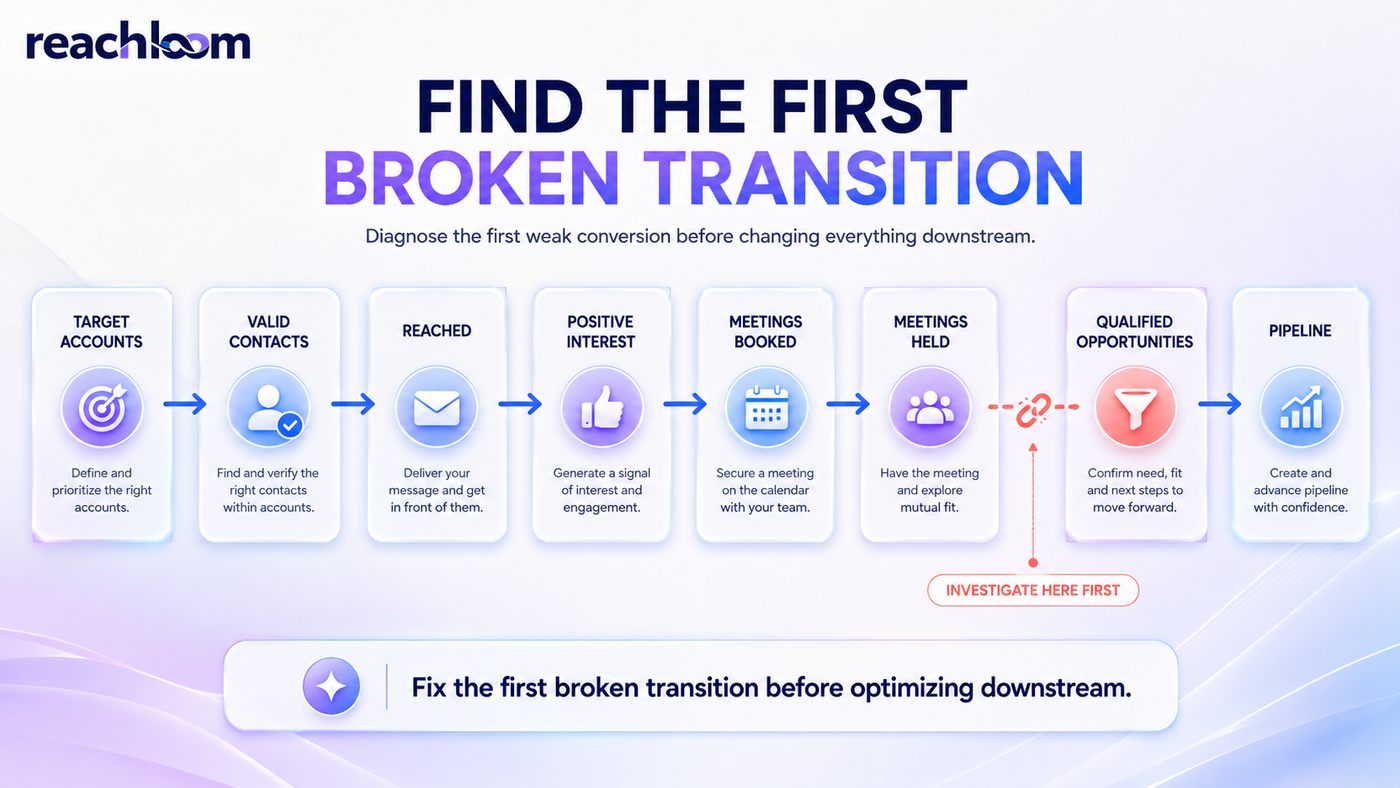
Target accounts → valid contacts → reached prospects → replies and conversations → positive interest → booked meetings → held meetings → qualified opportunities → pipeline
Find the first transition that is materially weaker than it should be. Then investigate the causes behind that transition before changing everything else.
That sounds simple. In practice, many outbound teams skip this step and start rewriting copy, changing tools, increasing sending volume, or replacing lists.
The result is more activity without knowing what was actually broken.
High activity and low pipeline are not contradictory
Activity measures whether work is happening.
Pipeline measures whether that work is successfully moving the right prospects through the commercial process.
Those are different things.
A team can execute thousands of outbound touches while targeting companies that are unlikely to buy.
A campaign can reach the right accounts while using stale contact data.
Emails can be delivered while the message gives the prospect no reason to care now.
Prospects can reply positively while conversations are handled too slowly to become meetings.
Meetings can be booked while qualification is loose enough that sales rejects most of them.
And legitimate opportunities can exist while CRM processes fail to attribute them back to outbound correctly.
That is why diagnosing outbound from total activity alone is dangerous.
You need to inspect the transitions.
Start with the outbound conversion chain
Instead of asking whether outbound is "working," break the motion into stages.
Stage
Question to answer
Target accounts
Are we selecting companies that genuinely fit the offer?
Contacts
Are we reaching the right people inside those companies?
Reachability
Can our email, LinkedIn, or other channels actually reach them?
Engagement
Are prospects responding or entering conversations?
Positive interest
Are those responses commercially relevant?
Meeting booked
Does interest convert into a scheduled conversation?
Meeting held
Are prospects actually showing up?
Qualified opportunity
Does sales believe there is a real problem, fit, and buying path?
Pipeline
Is qualified opportunity value being created and recorded?
Your goal is not to find the lowest-looking number.
Your goal is to find the first broken transition.
Everything after that stage may simply be a downstream consequence.
1. Lots of activity, but very few prospects are actually reached
Start with the most basic question.
Did your activity reach a real prospect?
A sequence being active does not mean the intended buyer saw the message.
For email, investigate things such as contact validity, sending infrastructure, domain health, authentication, bounce patterns, and whether the inbox setup is functioning as expected.
For LinkedIn, inspect connection acceptance, audience quality, account restrictions, prospect activity, and whether the profiles being targeted actually match the intended persona.
If this stage is weak, rewriting your offer is premature.
The prospect cannot respond to outreach they never meaningfully received.
What to investigate
Check whether:
- contact data is current
- titles still match the intended persona
- company and contact records have been matched correctly
- sending infrastructure is behaving normally
- the same prospects are being contacted repeatedly through overlapping campaigns
- channel capacity is hiding poor reachability
Fix the reachability problem before diagnosing message performance.
2. Prospects are reached, but almost nobody responds
Now targeting and relevance move to the top of the list.
This is where teams frequently jump straight to copy.
Sometimes the copy is the problem.
But messaging should not be evaluated independently from who received it and why they were selected.
A polished message sent to the wrong audience will still fail.
So will a relevant message sent at a completely irrelevant moment.
Ask three questions.
Are these actually the right companies?
Go beyond firmographic fit.
A company can match your employee count, industry, geography, and technology filters while having no meaningful reason to care about what you sell.
Look at the characteristics that exist in customers who actually buy.
Those may include company maturity, operating model, team structure, current systems, recent changes, regulatory pressure, hiring patterns, growth initiatives, or another condition closely connected to your offer.
Are these the right people?
An account can be perfect while the contact is wrong.
Check whether the person:
- owns the problem
- influences the problem
- is likely to feel the consequences
- has enough proximity to the initiative to understand the message
Do not assume the most senior title is automatically the best outbound contact.
Is there a reason to contact them now?
This is where signal-based outbound becomes useful.
A signal should provide context for prioritization, not merely another field to personalize.
A leadership change, hiring pattern, technology change, expansion, regulatory development, or strategic initiative can make one account more relevant than another.
But a signal is not automatically buying intent.
The useful question is:
Does this event increase the probability that the problem we solve matters to this account right now?
If not, the signal may be interesting without being commercially useful.
3. Prospects respond, but the replies are mostly negative or irrelevant
A reasonable reply rate can hide a weak campaign.
If prospects regularly respond but the responses are variations of:
"Not relevant."
"We don't do that."
"Wrong person."
"Already handled."
"No need."
then you do not primarily have a response problem.
You have a relevance problem.
Inspect the replies as data.
Group them by reason.
Reply pattern
Possible diagnosis
"Not relevant"
Weak ICP, weak problem selection, or poor timing
"Wrong person"
Persona or account mapping issue
"We already have this"
Offer differentiation or targeting issue
"Not a priority"
Timing, signal quality, or problem urgency issue
"What exactly do you do?"
Message clarity issue
Positive curiosity but no progression
CTA or conversation handling issue
Do not celebrate aggregate reply rate while ignoring reply quality.
The useful outcome is not getting prospects to type something back.
It is starting the right commercial conversations.
4. Positive replies happen, but meetings do not
At this point, continuing to optimize the opening message may produce very little value.
The prospect has already shown interest.
The leak exists after interest.
Review what happens immediately after a positive response.
Who owns the conversation?
How quickly does someone respond?
Does the reply continue the context of the original outreach?
Is the prospect forced into a booking link too early?
Is the conversation suddenly handed to someone who has no idea why the prospect replied?
Are qualification questions making the interaction feel like a form?
Does the prospect receive multiple messages from different people?
This stage deserves its own operating process.
A positive reply should not disappear into an inbox and depend on somebody noticing it.
Define ownership, classification, next action, and handoff.
5. Meetings are booked, but many never happen
A booked meeting is not yet pipeline.
If bookings are healthy but held meetings are weak, isolate the meeting stage rather than changing prospecting.
Review:
- how far in advance meetings are being scheduled
- whether the prospect clearly understands the purpose of the conversation
- reminder and confirmation logic
- whether context from the original outreach is preserved
- calendar ownership
- rescheduling procedures
- what happens after a cancellation or no-show
The objective is to remove friction between genuine interest and the actual conversation.
6. Meetings happen, but sales does not create opportunities
This is one of the most useful diagnostic signals in outbound.
Marketing, SDR, agency, or outbound teams may believe performance is strong because meetings are happening.
Sales may believe lead quality is poor because the meetings are going nowhere.
Both sides can be looking at accurate metrics.
The real issue is the transition between meeting and qualified opportunity.
Start by defining what a qualified outbound meeting actually means.
That definition should be explicit enough that two people evaluating the same meeting would usually reach the same conclusion.
Then review failed meetings.
Look for patterns.
Were the companies wrong?
Was the persona too junior?
Was there no real problem?
Was timing wrong?
Did the prospect misunderstand the reason for the meeting?
Was the meeting accepted because the outreach created curiosity rather than commercial relevance?
This is where the feedback loop back into targeting matters.
A failed meeting is not just a sales outcome.
It is information about the upstream outbound system.
7. Opportunities are being created, but pipeline still looks weak
Now inspect value and attribution.
Ten small opportunities may represent less commercial value than two strong ones.
Measure outbound beyond meeting volume.
Useful questions include:
- Which ICP segments create opportunity value?
- Which signals create qualified opportunities?
- Which channels contribute to those opportunities?
- Which campaigns generate meetings but little pipeline?
- Which personas enter opportunities that progress?
- Which opportunities were influenced by multiple outbound channels?
- Is outbound attribution disappearing during the CRM handoff?
This is where activity metrics become much less useful than outcome metrics.
The objective is not maximum outbound motion.
It is commercial movement.
Use conversion rates between stages, not one headline metric
For every stage, calculate the transition into the next stage.
For example:
Positive reply conversion = positive replies ÷ reached prospects
Meeting conversion = meetings booked ÷ positive conversations
Held-meeting conversion = meetings held ÷ meetings booked
Opportunity conversion = qualified opportunities ÷ meetings held
Pipeline per opportunity = outbound pipeline value ÷ qualified opportunities
Do not treat these as universal benchmarks.
Different markets, average contract values, offers, personas, channels, and sales cycles can produce very different numbers.
Instead, compare meaningful cohorts.
Compare:
- one ICP against another
- one signal against another
- one persona against another
- one campaign against another
- one time period against another
- one channel sequence against another
That tells you much more than comparing your team with an arbitrary internet average.
Do not change five variables at once
Once you find the likely broken stage, resist the temptation to rebuild the entire campaign.
Changing the list, copy, sending volume, offer, sequence, and CTA simultaneously may produce a different result.
It will not tell you which change caused it.
A better process is:
- Identify the broken transition.
- Write down the most likely cause.
- Decide what evidence would support or reject that explanation.
- Change the smallest useful variable.
- Run the test on a comparable cohort.
- Record the result.
- Keep, reject, or refine the hypothesis.
Outbound optimization should create knowledge, not just activity.
What not to do when pipeline is weak
Do not automatically send more
Volume magnifies the system you already have.
If the audience, data, offer, infrastructure, or qualification model is weak, additional volume can simply expose the weakness to more prospects.
Do not automatically rewrite the copy
Poor messaging is real.
It is also one of the easiest explanations to blame because everybody can see the email.
The real failure may sit underneath it.
Targeting, data quality, reachability, timing, reply handling, qualification, and CRM processes can all affect the final outcome.
Do not automatically buy another tool
Tools can improve execution.
They cannot decide whether your commercial assumptions are correct.
Before adding another platform, define the specific failure it is supposed to solve.
Do not optimize around vanity metrics
More sends, connections, opens, replies, and meetings can all coexist with weak pipeline.
Track them because they help diagnose individual stages.
Do not confuse them with the commercial outcome.
The fastest way to diagnose outbound is to work backwards from pipeline
Start with the business outcome.
How much qualified outbound pipeline was created?
Then move one stage backwards.
How many qualified opportunities produced it?
Then:
How many held meetings produced those opportunities?
How many booked meetings produced those conversations?
How many positive responses produced those meetings?
How many reached prospects produced those responses?
Which accounts and contacts produced the reached prospects?
Eventually you reach the first transition where the pattern breaks.
That stage becomes the priority.
This is much more useful than asking whether the entire outbound program is good or bad.
A practical outbound diagnostic scorecard
For every campaign or segment, keep one view containing:
Area
What to capture
ICP
Segment, company criteria, persona
Context
Signal or reason for prioritization
Data
Contact source, verification status
Channel
Email, LinkedIn, phone, or coordinated sequence
Engagement
Replies and conversations
Reply quality
Positive, neutral, negative, wrong person
Meetings
Booked, held, no-show
Qualification
Qualified or disqualified, including reason
Pipeline
Opportunity created and value
Outcome
Progressed, closed won, closed lost
Now you can ask questions that activity dashboards cannot answer.
Which signal produces the strongest qualified conversations?
Which ICP creates the most meetings but the least opportunity value?
Which campaign gets fewer replies but better pipeline?
Which persona progresses furthest?
Which channel is creating the conversation, and which channel is assisting it?
Those are outbound operating questions.
So, why is your outbound creating activity but no pipeline?
Usually because one stage in the system is failing to convert the output of the stage before it.
The mistake is treating the whole motion as one problem.
Do not begin with:
"How do we improve outbound?"
Begin with:
"Where is the first meaningful conversion breakdown?"
Then diagnose that stage.
If prospects are not being reached, investigate data and infrastructure.
If they are reached but ignore you, investigate targeting, timing, relevance, and messaging.
If they reply but do not book, investigate conversation handling.
If they book but do not attend, investigate the meeting process.
If they attend but do not qualify, investigate targeting, expectations, and qualification.
If qualified opportunities exist but pipeline is invisible, investigate measurement and CRM attribution.
Fix the first broken transition before trying to optimize everything downstream.
Frequently asked questions
Why do we have high outbound activity but no pipeline?
High activity with little pipeline usually means one or more conversion stages between prospecting and qualified opportunity creation are weak. Break the process into targeting, reachability, engagement, positive responses, meetings, qualification, and pipeline creation, then identify the first stage where performance falls away.
Should we increase outbound volume if pipeline is low?
Not until you understand why the existing activity is failing to convert. Increasing volume can amplify weak targeting, poor data, irrelevant messaging, or bad qualification. Diagnose the conversion chain first.
How do I know whether targeting or messaging is the problem?
Compare performance across controlled cohorts. If multiple messages fail with the same segment, investigate the audience and timing. If the same audience responds very differently to a meaningful messaging change, the message may be contributing more heavily. Avoid changing targeting and messaging simultaneously if you want a useful answer.
What should an outbound team measure?
Measure each transition from target account through qualified pipeline. Activity metrics are useful for diagnosing execution, but they should connect to replies, positive conversations, meetings, held meetings, qualified opportunities, pipeline value, and ultimately revenue outcomes.
When should an outbound campaign be paused?
Pause or reduce activity when continuing the campaign would create more exposure without producing useful learning. Examples include obvious audience mismatch, infrastructure problems, unreliable contact data, major tracking gaps, or repeated evidence that the underlying offer or segment hypothesis needs to be revisited.
If you still cannot identify what is broken
Sometimes the problem really is isolated.
Sometimes targeting, infrastructure, workflow, messaging, replies, qualification, and CRM processes are interacting with each other.
That is when adding another tactic usually creates more noise.
Reachloom's GTM Strategy & Advisory work starts with the diagnosis. We look at the parts of the outbound motion connected to the problem, identify the highest-priority issues, and map what should happen next.
If the diagnosis points to a specific execution problem, the next step may be a Clay + GTM build, cold email infrastructure work, intent-based LinkedIn outreach, or a fully managed signal-based outbound motion.
The goal is not to add more outbound activity.
It is to make the existing system explainable enough that you know what to fix.