

Outbound Books Meetings but Creates No Opportunities? Fix the Qualification Gap
Your outbound can book meetings and still create almost no qualified pipeline. Diagnose whether the gap starts with targeting, meeting quality, discovery, qualification, handoff, or CRM rules.
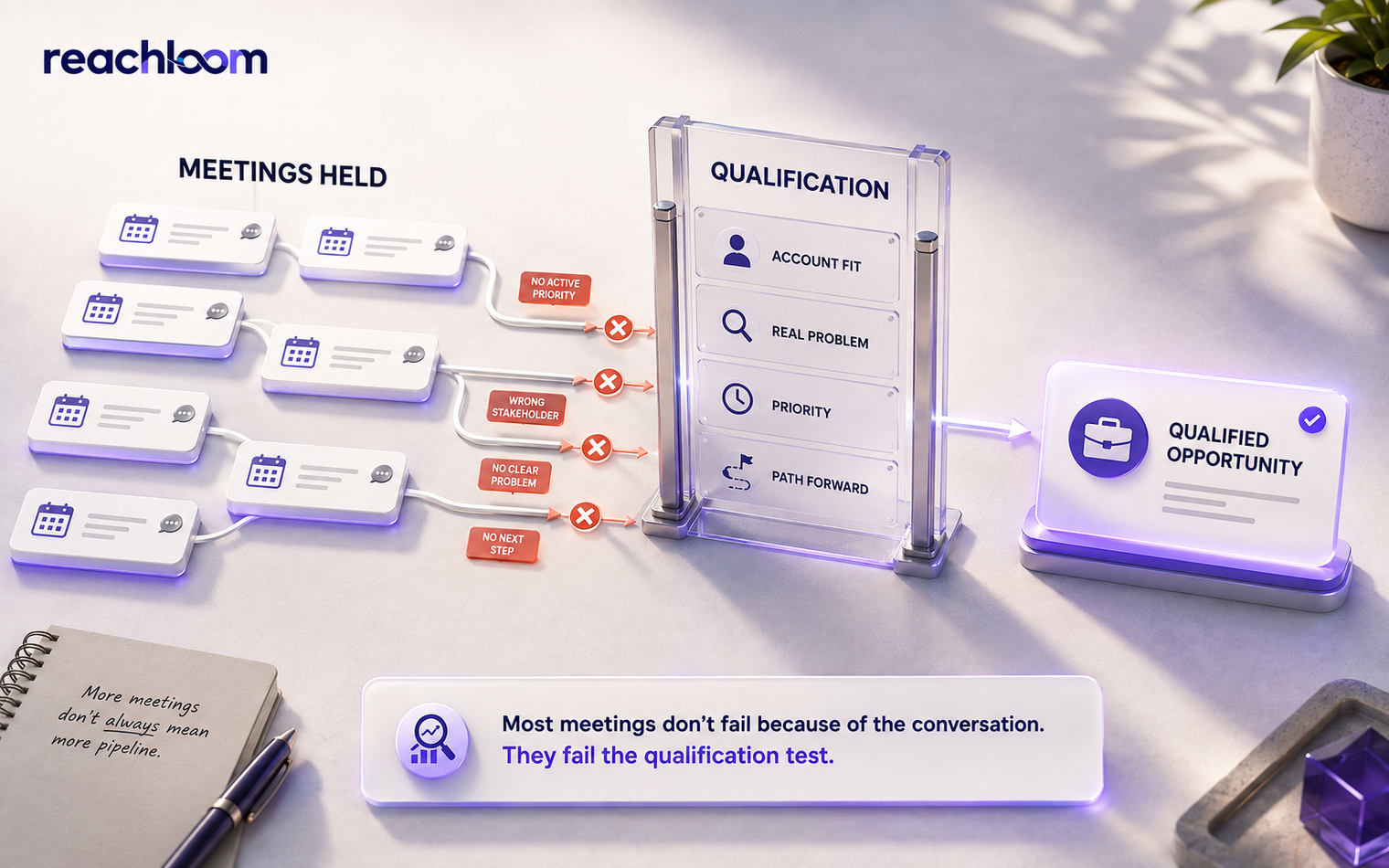
Your outbound team is booking calls.
Prospects are showing up.
The calendar looks healthy.
But when you look at qualified opportunities, almost nothing is moving.
That creates an uncomfortable question:
Are we generating bad meetings, or are we failing to turn good meetings into opportunities?
Those are not the same problem.
A weak meeting-to-opportunity conversion can start before the meeting is ever booked. It can come from poor account selection, weak qualification, misunderstood buying signals, the wrong stakeholder, loose meeting criteria, ineffective discovery, inconsistent opportunity definitions, or a CRM process that fails to record legitimate opportunities correctly.
The goal is not to book more meetings.
The goal is to identify why meetings are not becoming commercially credible opportunities and fix the first point where that transition breaks.
If the entire outbound motion is producing activity but little pipeline, start with our broader guide to finding the broken stage.
This article focuses specifically on one transition:
Meetings held → qualified opportunities
A booked meeting is not a qualified opportunity
This distinction sounds obvious, but many outbound systems blur it.
A meeting tells you that someone agreed to speak.
A qualified opportunity tells you that the conversation uncovered enough evidence to justify continued sales effort.
Those are different thresholds.
Your exact qualification criteria will depend on your sales motion. A short-cycle SMB sale should not necessarily use the same opportunity threshold as a complex enterprise sale with multiple stakeholders.
But at minimum, your team should be able to answer questions such as:
- Is this an account we genuinely want to sell to?
- Is there a relevant problem or desired outcome?
- Is solving it important enough to continue discussing?
- Are we speaking with the right stakeholder, or do we have a credible path to them?
- Is there a reason for this conversation to progress now?
- Is there an agreed next step that moves the evaluation forward?
You may not know every answer on the first call.
You do, however, need enough evidence to justify pursuit.
That is the real difference between a meeting and an opportunity.
What is the qualification gap?
The qualification gap is the difference between:
what your outbound process considers worth booking
and
what your sales process considers worth pursuing.
When those two definitions drift apart, the symptoms usually look like this:
What you see
What may actually be happening
Many meetings, few opportunities
Booking criteria may be too loose
Good conversations, no next steps
Discovery is not establishing a reason to continue
Correct ICP companies, poor meeting quality
ICP fit is being confused with buying relevance
Senior prospects attend but deals go nowhere
Title is being confused with authority or priority
Strong response to a signal, weak commercial interest
The signal was relevant context, not actual buying intent
AEs reject SDR meetings
SDR and AE qualification standards are misaligned
Meetings seem qualified but pipeline remains low
CRM opportunity rules or handoff may be hiding legitimate progress
This is why simply telling SDRs to “qualify harder” is not enough.
First determine where the gap originates.
1. Your booking criteria may be too weak
One of the simplest causes is also one of the easiest to overlook:
The bar for getting onto the calendar is lower than the bar for becoming an opportunity.
That can happen when an outbound team optimizes heavily for meetings booked.
The prospect:
- matches a broad ICP
- has the right title
- responded positively
- agreed to speak
So the meeting gets booked.
But none of those facts proves there is a sales opportunity.
Someone can be the right persona at the right company and still have no active problem, no current priority, and no reason to change anything.
The meeting is real.
The opportunity is not.
What to inspect
Review a sample of held meetings that did not progress.
Do not start by rewriting outbound copy.
Instead ask:
- Why was this account selected?
- Why was this person selected?
- What made us believe the conversation was timely?
- What evidence existed before the call?
- What new evidence emerged during the call?
- Why did sales decide not to continue?
You are trying to determine whether the meeting was poorly qualified before booking or properly booked but poorly converted during discovery.
Those require different fixes.
2. ICP fit may be getting mistaken for buying readiness
An ICP tells you who could be a good customer.
It does not automatically tell you who is ready for a sales conversation today.
A company can match every firmographic requirement and still have:
- no relevant initiative
- no meaningful pain
- no internal urgency
- no available resources
- no reason to evaluate alternatives
- no stakeholder willing to move the issue forward
Firmographic fit creates eligibility.
It does not create demand.
This becomes especially important in outbound because you are initiating the conversation instead of responding to an explicit request.
A strong outbound system therefore needs a reason for:
why this account, why this person, and why now.
That is where signals can help.
But signals also create another qualification problem.
3. A signal is not automatically buying intent
Imagine your system detects that a target company:
- hired a new executive
- expanded into a new market
- changed technology
- raised funding
- posted a relevant job
- launched a new initiative
- experienced a regulatory change
That information can make outreach more relevant.
But it does not automatically mean:
They are buying what you sell right now.
A signal gives you context.
It may create a useful hypothesis.
It may improve prioritization.
It may change who you contact and what you say.
But the meeting still has to validate whether the signal connects to an actual commercial problem or priority.
This distinction is central to good signal-based managed outbound.
Signals should influence who gets contacted, why now, and what context is used.
They should not simply become another reason to increase outreach volume.
If signal-generated meetings repeatedly fail qualification, inspect the interpretation of the signal before abandoning the signal itself.
Ask:
What did we assume this signal meant, and did the meeting actually confirm that assumption?
That question can expose a large amount of false-positive targeting.
4. You may be reaching the right company but the wrong stakeholder
A meeting can feel successful because the prospect:
- understands the problem
- likes the idea
- asks intelligent questions
- engages with the conversation
Yet it still fails to become an opportunity.
Sometimes the problem is not interest.
It is commercial relevance inside the buying process.
The person may be:
- a user but not an owner
- an influencer but not a decision-maker
- interested but unable to mobilize others
- senior enough to talk but disconnected from the initiative
- responsible for the function but not the budget
- affected by the problem but unable to prioritize solving it
The fix is not necessarily to target only executives.
A senior title can be just as misleading as a junior one if the person is disconnected from the problem.
The better question is:
Which role can actually move this specific problem forward?
Sometimes that is an executive.
Sometimes it is an operational owner.
Sometimes the first contact is useful primarily because they can lead you to the correct stakeholder.
That should be part of the qualification logic.
5. The first meeting may be too focused on the pitch
Another failure happens after a perfectly reasonable meeting has been booked.
The account fits.
The prospect has some relevance.
There may even be a legitimate problem.
But the call becomes a product or service presentation before the commercial context is clear.
The seller explains:
- capabilities
- features
- workflows
- integrations
- differentiators
The prospect says:
“Interesting.”
The meeting feels positive.
Then nothing happens.
There is no opportunity because the conversation never established why a buying process should exist.
Good discovery should help clarify:
- what is happening today
- why it matters
- what consequence it creates
- whether fixing it is actually a priority
- what has already been tried
- what a better outcome would look like
- who else is involved
- what would have to happen next
This is why an engaged prospect is not necessarily a qualified prospect.
Interest makes the conversation easier.
Commercial evidence makes the opportunity real.
6. Your team may not agree on what an opportunity actually is
This is one of the most important checks.
Ask your SDR leader, an AE, RevOps, and the sales leader independently:
When should we create an opportunity in the CRM?
If you receive four different answers, the problem is larger than outbound.
One rep may create an opportunity after the first discovery call.
Another may wait until pain and timing are confirmed.
Another may require access to a decision-maker.
Another may wait until a proposal or commercial evaluation is likely.
Now imagine trying to calculate meeting-to-opportunity performance across those four definitions.
The number becomes unreliable.
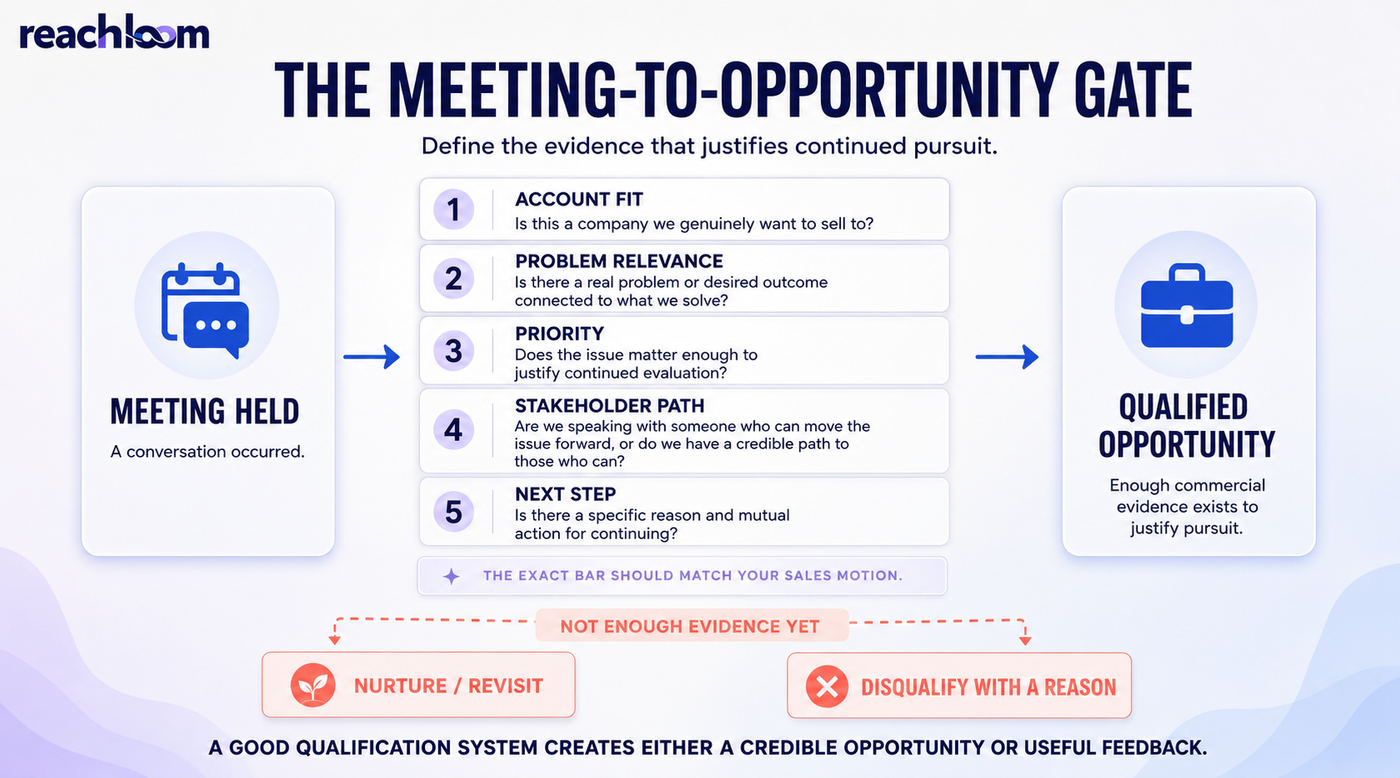
Before optimizing conversion, write down what your company means by:
Qualified Opportunity
Avoid vague definitions such as:
“A good prospect who showed interest.”
A more operational definition might be:
An account that fits our target customer criteria where the sales conversation has confirmed a relevant business problem or desired outcome, sufficient priority to justify continued evaluation, a credible stakeholder path, and a mutually understood next step.
That is an example, not a universal definition.
Your actual threshold should reflect your deal size, sales cycle, buying committee, and sales motion.
The important part is that everyone uses the same threshold.
7. The SDR-to-sales handoff may be losing the context that made the meeting relevant
Sometimes the outbound targeting is good.
The meeting is legitimate.
The SDR has useful context.
Then the handoff strips it away.
The AE receives:
“Meeting booked with VP Sales. Interested in outbound.”
That is not enough.
Useful handoff context may include:
- why the account was prioritized
- what signal or trigger influenced outreach
- what hypothesis the outreach was based on
- what the prospect responded to
- what problem they mentioned
- who initiated the conversation
- what expectation was set for the meeting
- what is still unknown
Without that context, the salesperson may restart the conversation from zero.
The prospect repeats information.
Discovery becomes generic.
The original reason for the conversation gets lost.
A meeting with legitimate potential can die because the outbound-to-sales transition was poorly designed.
8. Your CRM may be hiding real opportunities
There is another possibility teams often miss.
The meeting may have been good.
Sales may even be progressing it.
But the CRM does not show an opportunity.
Before concluding that meeting quality is poor, inspect your opportunity-creation process.
Ask:
- At what stage does an AE actually create the opportunity record?
- Is creation delayed until after a second meeting?
- Are opportunities sometimes tracked as leads or contacts first?
- Are reps consistently following the process?
- Do held meetings have required outcomes recorded?
- Can RevOps distinguish “not qualified” from “qualified but not yet created”?
- Are opportunity records tied back to their original outbound source?
If your data model cannot distinguish these outcomes, your meeting-to-opportunity conversion rate may be measuring CRM behavior as much as sales quality.
That creates a dangerous feedback loop.
Outbound gets blamed for poor meetings.
Targeting changes.
Messaging changes.
Campaigns get replaced.
But the original diagnosis was wrong.
How to diagnose the qualification gap step by step
Do not rewrite messaging, change the ICP, retrain sales, rebuild CRM stages, and alter qualification rules simultaneously.
Use a controlled sequence.
Step 1: Define the opportunity bar
Write down the minimum evidence required before your company considers something a qualified opportunity.
Keep it short enough that reps can actually use it.
Account fit
Is this a company we genuinely want to sell to?
Problem relevance
Is there a real problem, constraint, or desired outcome connected to what we solve?
Priority
Is there evidence that the issue matters enough to continue discussing?
Stakeholder path
Are we speaking with someone who can influence progress, or do we have a credible route to the people who can?
Next step
Has the conversation produced a specific reason and action for continuing?
Do not turn this into an interrogation checklist.
The framework exists to create consistency.
Step 2: Separate meeting qualification from opportunity qualification
You need two different thresholds.
Booking qualification
Should this person and account have a conversation with sales?
Opportunity qualification
After the conversation, is there enough commercial evidence to justify active pursuit?
The first threshold should not be so strict that outbound is expected to fully qualify a complex sale through a cold email.
The second should not be so loose that every conversation becomes pipeline.
The job is to establish a sensible boundary between the two.
Step 3: Add reason codes for meetings that do not progress
Do not record every failed meeting as:
Not interested
That destroys the feedback loop.
Use a small controlled set of outcome reasons.
For example:
- wrong account
- wrong stakeholder
- no relevant problem
- problem exists but low priority
- timing not active
- no internal path forward
- current solution sufficient
- poor meeting fit
- nurture or revisit later
- qualified, opportunity created
- qualified, opportunity creation pending
The exact taxonomy can vary.
What matters is that a failed meeting becomes structured information rather than disappearing into a generic status.
Step 4: Segment meeting-to-opportunity performance
Do not look only at the company-wide number.
Compare performance by:
- ICP segment
- company size
- persona
- campaign
- signal
- message angle
- offer
- SDR
- AE
- geography
- source channel
You do not need a universal industry benchmark to learn something useful.
You need to identify where your own conversion changes materially.
If one signal repeatedly produces meetings but rarely produces opportunities, inspect what the signal is actually predicting.
If one persona produces strong opportunities while another produces mostly curiosity, adjust targeting.
If one salesperson converts similar meetings materially better than another, inspect discovery and opportunity standards before changing outbound.
The purpose is not to build another dashboard.
It is to isolate the cause.
Step 5: Review actual meetings, not just CRM outcomes
Take a sample of:
- meetings that became opportunities
- meetings that did not
- meetings rejected by sales
- meetings that looked promising but stalled
Compare what happened.
Look for differences in:
- why the account was targeted
- what caused the prospect to respond
- stakeholder relevance
- problem clarity
- urgency or priority
- next steps
- objections
- discovery quality
- handoff quality
You are looking for patterns that separate a good conversation from a commercially actionable conversation.
Step 6: Feed disqualification reasons back into outbound
This is where many systems stop working.
Sales learns why meetings are weak.
Outbound continues targeting the same accounts anyway.
The feedback needs to change future execution.
If meetings fail because of wrong account, refine the ICP or exclusion criteria.
If meetings fail because of wrong stakeholder, change persona targeting or create a better stakeholder path.
If meetings fail because there is no active priority, improve timing and signal selection.
If meetings fail because of weak problem relevance, revisit the problem hypothesis or offer.
If the prospect expected something different, fix the messaging and meeting expectation.
If it was a good meeting but weak discovery, inspect the sales process.
If the meeting was qualified but not recorded, fix the CRM workflow or opportunity definition.
That is how meeting outcomes make the outbound system smarter.
How to know whether the fix is working
Do not evaluate the change by meeting volume alone.
Track the transitions:
Positive conversations → meetings booked
Meetings booked → meetings held
Meetings held → qualified opportunities
Qualified opportunities → pipeline
The key metric for this particular problem is:
Qualified opportunities created ÷ meetings held
But the percentage is not the diagnosis.
Track the reasons behind the meetings that do not convert.
Over time, you want more held meetings producing one of two useful outcomes:
- A legitimate qualified opportunity.
- A clear, explainable disqualification that improves future targeting.
Both provide value.
What you want to eliminate is the middle:
Meetings that produce no opportunity, no useful learning, and no improvement to the outbound system.
Do not solve a qualification problem by simply booking fewer meetings
There is an easy overcorrection.
Sales complains about meeting quality.
Outbound responds by making booking criteria extremely strict.
Meeting volume falls.
Everyone assumes quality improved.
But sometimes the team has simply moved too much discovery into the pre-meeting stage.
That can be damaging in complex B2B sales where prospects may not disclose detailed budget, internal politics, decision criteria, or purchasing timelines before having a real conversation.
The objective is not:
maximum qualification before booking.
It is:
enough evidence to justify the meeting, followed by enough discovery to justify the opportunity.
The balance depends on your sales motion.
The fastest diagnostic: work backward from meetings that did not become opportunities
Start with a recent sample of held outbound meetings that failed to progress.
For each one, answer:
- Why was this account targeted?
- Why was this person targeted?
- Why did we believe the timing was relevant?
- What did the prospect respond to?
- Did the meeting confirm the original hypothesis?
- Was a real problem identified?
- Was it important enough to act on?
- Was the stakeholder commercially relevant?
- Was there a credible next step?
- Why exactly was no opportunity created?
Then group the reasons.
If most failures originate before the meeting, fix outbound targeting and booking qualification.
If they originate during the conversation, inspect discovery and opportunity qualification.
If the conversations are genuinely good but opportunity records are missing, fix CRM and handoff.
That separation matters more than another campaign rewrite.
A practical qualification-gap scorecard
Diagnostic question
Healthy evidence
Warning sign
Are the right accounts being booked?
Strong fit with target customer definition
Meetings come from marginal segments
Is the timing hypothesis real?
Signal or context connects to a current issue
Signal creates curiosity only
Is the stakeholder relevant?
Can influence progress or provide a path forward
Interested but isolated from buying process
Is there a real problem?
Prospect describes a meaningful challenge or desired outcome
Conversation stays hypothetical
Does the problem matter now?
Clear priority, consequence, initiative, or timing context
“Interesting, maybe later”
Is there a next step?
Specific mutual action
Generic follow-up or “send information”
Is opportunity creation consistent?
Shared definition across SDR, AE, and RevOps
Every rep uses a different threshold
Is failure data fed upstream?
Outcome reasons change targeting and messaging
The same weak meetings keep repeating
Do not use this simply to create another score.
Use it to determine what should change next.
FAQ
Why are our outbound meetings not turning into opportunities?
The problem can sit in account selection, stakeholder targeting, timing, signal interpretation, booking qualification, discovery, opportunity criteria, handoff, or CRM recording.
The fastest way to diagnose it is to review held meetings and identify the first point where commercially relevant evidence disappears.
What is a good meeting-to-opportunity conversion rate?
There is no single useful rate for every B2B company because the definitions of both “meeting” and “qualified opportunity” vary by sales motion, deal size, channel, and qualification standard.
Your own historical conversion by segment, persona, campaign, signal, and seller is usually more useful for diagnosis than a generic industry benchmark.
Is a booked meeting a qualified lead?
Not necessarily.
A booked meeting shows willingness to have a conversation.
Qualification requires additional evidence about fit, problem relevance, priority, stakeholder path, timing, or the buying process depending on your sales motion.
Should SDRs fully qualify prospects before booking meetings?
Not necessarily.
In more complex B2B sales, requiring complete qualification before a meeting can prevent legitimate opportunities from reaching sales.
The outbound team should establish enough relevance to justify the conversation. Sales can then validate whether enough commercial evidence exists to justify an opportunity.
Can targeting cause poor meeting-to-opportunity conversion?
Yes.
If outbound consistently books accounts or people who fit superficially but lack a relevant problem, active priority, stakeholder path, or timing context, the meetings may be real conversations without being credible sales opportunities.
Can the CRM make meeting conversion look worse than it really is?
Yes.
If sellers create opportunities inconsistently, delay opportunity creation, or use different definitions, CRM reporting can distort the transition from meetings held to qualified opportunities.
Final takeaway
If outbound is booking meetings but qualified opportunities remain weak, do not assume you need more meetings.
Find out what those meetings are actually telling you.
The problem may start with:
- who you target
- why you target them now
- what gets someone onto the calendar
- what happens during discovery
- how opportunity quality is defined
- how SDRs and AEs hand context over
- how the CRM records the outcome
The goal is not to force every meeting into pipeline.
The goal is to build an outbound system where meetings either become credible sales opportunities or produce clear feedback that improves the next round of targeting.
Reachloom's Managed Outbound service is built around that full system, from account selection and signals through outreach, qualification, and meeting generation, with a focus on creating better pipeline rather than simply generating more activity.